TC — Traffic Control Classifier
Blog series: Part 13 — Packet logger with TC and XDP hooks · Part 14 — Firewall with Java & eBPF
Javadoc: TCHook
Source: TCHook.java
See also: XDP Hook · BPF Maps · LSM & Cgroup
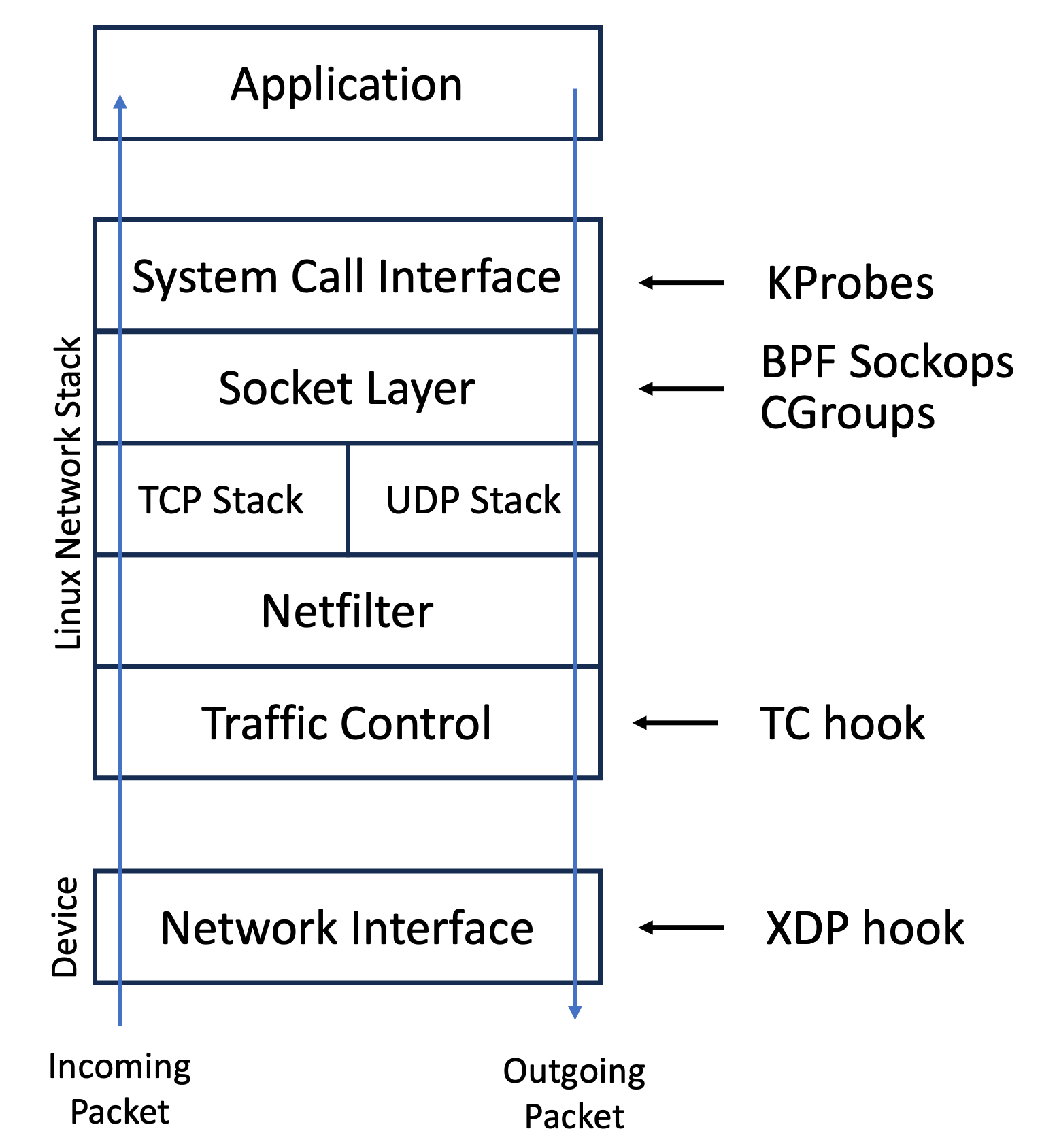
TC (Traffic Control) hooks let you inspect and modify packets at the Linux TC subsystem layer.
Unlike XDP which runs in the driver, TC programs operate on full sk_buff (socket buffer) objects,
giving you access to more metadata and the ability to modify packet contents after the kernel has
already parsed them.
When to use TC
- You need both ingress and egress hooks (XDP is ingress-only)
- You need to access socket metadata (
__sk_bufffields likemark,priority) - You want to modify packet contents (TC can rewrite headers)
- The NIC driver doesn't support XDP native mode
- You need to attach to virtual interfaces (veth, loopback)
Implementing TCHook
import me.bechberger.ebpf.annotations.bpf.BPF;
import me.bechberger.ebpf.annotations.bpf.BPFFunction;
import me.bechberger.ebpf.bpf.BPFProgram;
import me.bechberger.ebpf.bpf.TCContext;
import me.bechberger.ebpf.bpf.TCHook;
import static me.bechberger.ebpf.runtime.SkDefinitions.__sk_action;

@BPF(license = "GPL")
public abstract class MyTCProg extends BPFProgram implements TCHook {

    @Override
    @BPFFunction
    public __sk_action tcHandleIngress(TCContext skb) {
        return __sk_action.__SK_PASS;
    }

    @Override
    @BPFFunction
    public __sk_action tcHandleEgress(TCContext skb) {
        return __sk_action.__SK_PASS;
    }
}
You can implement one or both of tcHandleIngress and tcHandleEgress. The compiler plugin
generates SEC("tc/ingress") and SEC("tc/egress") sections respectively.
The __sk_buff context
| Field | Type | Description |
|---|---|---|
len |
int |
Total packet length |
pkt_type |
int |
Packet type (PACKET_HOST, PACKET_BROADCAST, …) |
mark |
int |
Packet mark (fwmark) — read/write |
queue_mapping |
int |
Queue mapping |
protocol |
int |
L3 protocol (ETH_P_IP, ETH_P_IPV6, …) |
vlan_present |
int |
Whether VLAN tag is present |
vlan_tci |
int |
VLAN TCI if present |
priority |
int |
TC priority — read/write |
ingress_ifindex |
int |
Ingress interface index |
ifindex |
int |
Current interface index |
data |
int |
Start of packet data |
data_end |
int |
End of packet data |
Return values
| Constant | Meaning |
|---|---|
__sk_action.__SK_PASS (= TC_ACT_OK) |
Accept packet, continue processing |
__sk_action.__SK_DROP (= TC_ACT_SHOT) |
Drop packet |
TC_ACT_UNSPEC |
Use default action |
TC_ACT_PIPE |
Pass to next filter in chain |
TC_ACT_REDIRECT |
Redirect to another interface |
Attaching the program
public static void main(String[] args) throws Exception {
    try (MyTCProg prog = BPFProgram.load(MyTCProg.class)) {
        // Attach ingress to all non-loopback interfaces
        prog.tcAttachIngress();

        // Or attach egress to all interfaces
        prog.tcAttachEgress();

        // Or attach to a specific interface by ifindex (from `ip link`)
        // prog.tcAttachIngress(ifindex);
        // prog.tcAttachEgress(ifindex);

        System.out.println("TC program attached. Ctrl-C to stop.");
        Thread.currentThread().join();
    }
    // Detached automatically on close()
}
Example — rate-limit by packet mark
@BPF(license = "GPL")
public abstract class MarkHeavyFlows extends BPFProgram implements TCHook {

    @BPFMapDefinition(maxEntries = 1024)
    final BPFHashMap<Integer, Long> bytesPerSrc = BPFHashMap.newInstance();

    final GlobalVariable<Long> threshold = new GlobalVariable<>(1_000_000L);

    @Override
    @BPFFunction
    public __sk_action tcHandleIngress(Ptr<__sk_buff> skb) {
        int src = skb.val().protocol;   // simplified — use actual IP src in production
        Ptr<Long> bytes = bytesPerSrc.bpf_get(src);
        long current;
        if (bytes == null) {
            current = skb.val().len;
        } else {
            current = bytes.val() + skb.val().len;
        }
        bytesPerSrc.bpf_put(src, current);

        if (current > threshold.get()) {
            // Mark the packet; tc/iptables rules can act on this
            Ptr.of(skb.val().mark).set(1);
        }
        return __sk_action.__SK_PASS;
    }

    @Override
    @BPFFunction
    public __sk_action tcHandleEgress(Ptr<__sk_buff> skb) {
        return __sk_action.__SK_PASS;
    }
}
Modifying packet data
TC programs can call bpf_skb_store_bytes and bpf_l3_csum_replace / bpf_l4_csum_replace
to rewrite headers in-place. These are raw BPF helpers available via BPFHelpers (not BPFJ).
Always recalculate checksums after modifying IP or TCP/UDP fields:
@BPFFunction
void rewriteDstPort(Ptr<__sk_buff> skb, int offset, short newPort) {
    // bpf_skb_store_bytes is a raw BPF helper — use BPFHelpers.bpf_skb_store_bytes(...)
    BPFHelpers.bpf_skb_store_bytes(skb, offset, Ptr.of(newPort), 2, BPF_F_RECOMPUTE_CSUM);
}
TC vs XDP comparison
| Aspect | XDP | TC |
|---|---|---|
| Hook location | Driver (pre-SKB) | After SKB allocation |
| Egress hook | No | Yes |
| Modify packet | Limited | Full |
| Overhead | Lowest | Low |
| Virtual interfaces | Limited | Yes |
| Kernel minimum | 4.8 | 4.1 |
Examples
TCDropEveryThirdOutgoingPacket.java— drop every third egress packetPacketLogger.java— log packets via TC + ring buffer