Global Variables & Types
Blog series: Part 10 — Global variables
Javadoc: GlobalVariable
Source: GlobalVariable.java
See also: BPF Maps · Kprobes · Tracepoints
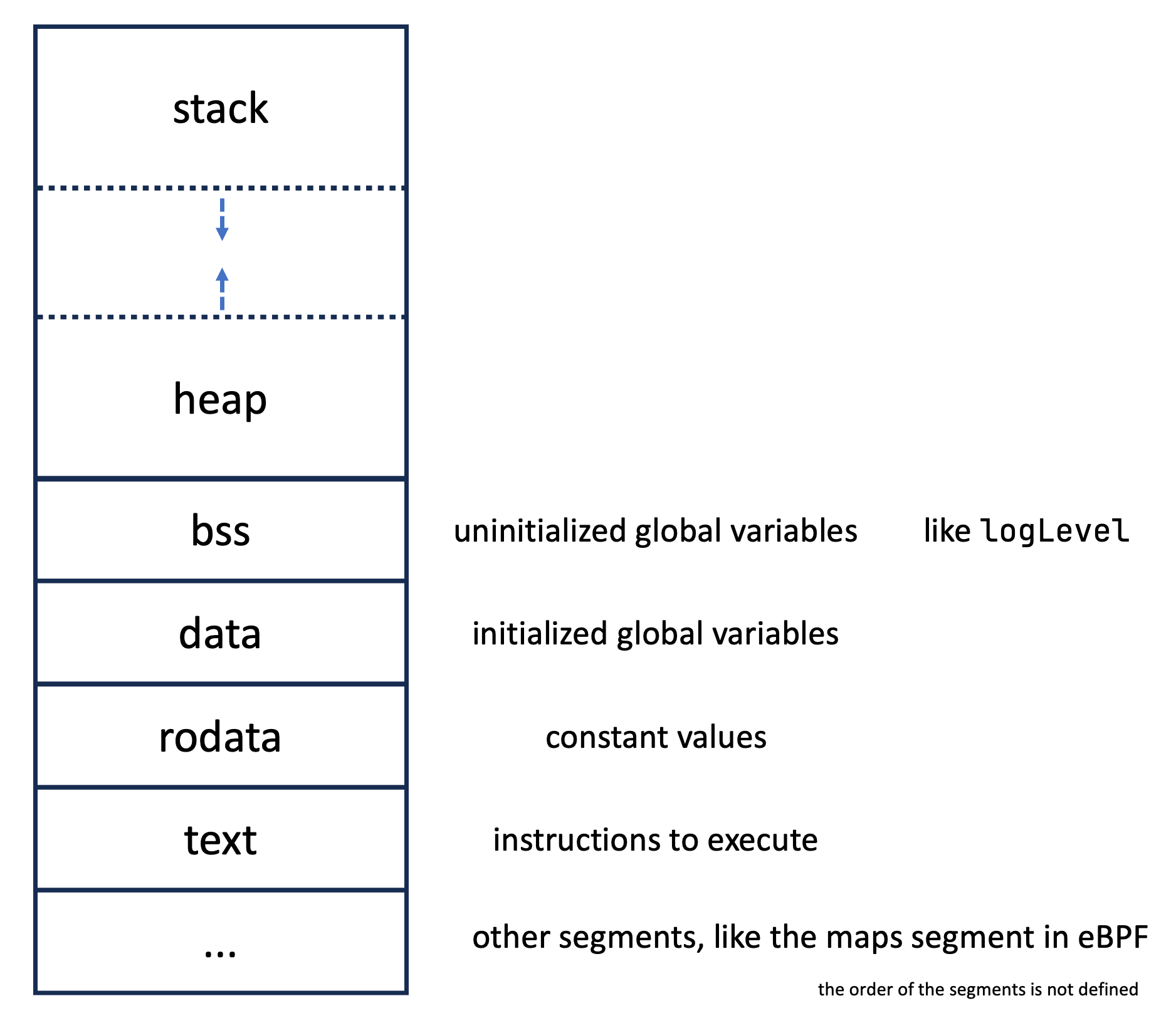
hello-ebpf provides a rich type system for sharing structured data between BPF programs and
Java. This page covers GlobalVariable<T>, @Type records, @Size(N), and @Unsigned.
GlobalVariable
GlobalVariable<T> creates a BPF array map of size 1 that is mmap'd into user-space. Both the
BPF program and the Java side can read and write it with low overhead (no syscall on the read path).
Declaration
@BPF(license = "GPL")
public abstract class MyProg extends BPFProgram {

    // Primitive wrappers
    final GlobalVariable<Long>    counter  = new GlobalVariable<>(0L);
    final GlobalVariable<Integer> flags    = new GlobalVariable<>(0);
    final GlobalVariable<Boolean> enabled  = new GlobalVariable<>(true);

    // Struct (use @Type record — see below)
    final GlobalVariable<Config>  config   = new GlobalVariable<>(new Config(0, 0));
}
The initial value passed to the constructor is written into the map at load time.
Each call to BPFProgram.load(MyProg.class) creates a fresh map — values do not
persist across runs.
BPF-side access (inside @BPFFunction)
@BPFFunction
public int xdpHandlePacket(Ptr<xdp_md> ctx) {
    if (!enabled.get()) return XDP_PASS;

    long c = counter.get();
    counter.set(c + 1);

    return XDP_PASS;
}
The compiler plugin translates .get() to a BPF map lookup dereference and .set(v) to
a map element write.
Java-side access
// Read
long c = prog.counter.get();

// Write
prog.counter.set(42L);

// Atomic operations (Java side only, via Unsafe)
prog.counter.incrementAndGet();
prog.counter.addAndGet(10L);
prog.counter.compareAndSet(42L, 0L);   // CAS
Thread safety
Java-side reads and writes to GlobalVariable are not atomic by default because they go
through mmap. Use incrementAndGet() / compareAndSet() for concurrent Java access.
BPF-side atomics require explicit __sync_fetch_and_add (see Atomics section in helpers).
@Type records
@Type records map directly to C structs. Use them as map values, ring buffer elements,
or GlobalVariable types.
import me.bechberger.ebpf.annotations.Type;
import me.bechberger.ebpf.annotations.Size;
import me.bechberger.ebpf.annotations.Unsigned;

@Type
record Event(
    int   pid,
    int   tgid,
    long  timestampNs,
    @Size(256) String filename,   // char filename[256]
    @Unsigned int returnCode      // u32 returnCode
) {}
The compiler plugin generates:
Nested structs
@Type
record IpPort(int addr, short port) {}

@Type
record Connection(IpPort src, IpPort dst, long bytes) {}
Generates nested C structs. The outer struct is padded according to C alignment rules
(which match Java @Type record layout).
Creating instances in BPF code
@BPFFunction
public void handleEvent(Ptr<some_ctx> ctx) {
    // Allocate on stack
    Event e = new Event();
    e.pid  = BPFJ.currentPid();
    e.tgid = BPFJ.currentTgid();
    // ... fill fields ...
    events.bpf_put_some_key(e);   // or ring buffer submit
}
@Size(N) — fixed-length strings
Java String fields in @Type records must be annotated with @Size(N) to specify the
character array length. Without @Size, the compiler plugin will reject the type.
@Type
record ProcessInfo(
    int pid,
    @Size(16) String comm,       // char comm[16] — fits TASK_COMM_LEN
    @Size(256) String cmdline    // char cmdline[256]
) {}
Initialising string buffers in BPF code
Use BPFJ.charBuf(N) to create a zero-initialised stack buffer of exactly N bytes:
@BPFFunction
public void captureComm() {
    // Stack-allocated char buf[16] = {}
    var buf = BPFJ.charBuf(16);
    BPFJ.getCurrentComm(buf);
    // buf now contains the current process name, null-terminated
}
@Unsigned
Java integers are signed. Use @Unsigned to tell the compiler plugin to treat the value
as an unsigned type in generated C.
| Java annotation | C type |
|---|---|
@Unsigned byte |
__u8 |
@Unsigned short |
__u16 |
@Unsigned int |
__u32 |
@Unsigned long |
__u64 |
@Type
record PacketStats(
    @Unsigned long rxBytes,   // __u64
    @Unsigned long txBytes,   // __u64
    @Unsigned int  drops      // __u32
) {}
Class-level constants
Compile-time constants on a @BPF class become static const in generated C:
@BPF(license = "GPL")
public abstract class MyProg extends BPFProgram {

    // These become: static const int MAX_ENTRIES = 1024;
    //               static const int THRESHOLD = 100;
    static final int MAX_ENTRIES = 1024;
    static final int THRESHOLD   = 100;

    @BPFMapDefinition(maxEntries = MAX_ENTRIES)
    final BPFArray<Long> buckets = BPFArray.newInstance();

    @BPFFunction
    public void process(int value) {
        if (value > THRESHOLD) {
            // ...
        }
    }
}
Only static final fields with primitive types and compile-time constant expressions are
supported. Non-constant initialisers will cause a compiler plugin error.
Padding and alignment
C structs may have implicit padding between fields for alignment. The @Type annotation
generates structs that match the standard C ABI (same as what GCC/clang would produce).
When sharing structs across the Java/BPF boundary, field order matters:
- Place 8-byte fields (
long,__u64) first - Then 4-byte fields (
int,__u32) - Then 2-byte fields (
short) - Then 1-byte fields (
byte,char) - String arrays (
@Size(N) String) count as N bytes
This avoids padding holes and ensures the Java and C representations match without manual
__attribute__((packed)) annotations.